Almost every stucco wall in Southern Utah cracks at some point. Some cracks are cosmetic. Others are the wall telling you the ground moved or water found a way in. The trick is knowing which is which, and fixing the cause along with the line you can see.
Tell us what you’re seeing and we’ll get a team over for a free written estimate.
Text us a photo at [435 NUMBER]
Signs to look for
Hairline cracks
Very thin lines, often in a random web pattern, that you can’t fit a fingernail into. They usually stay in the finish coat. Common on newer homes in the first few years.
Stair step cracks
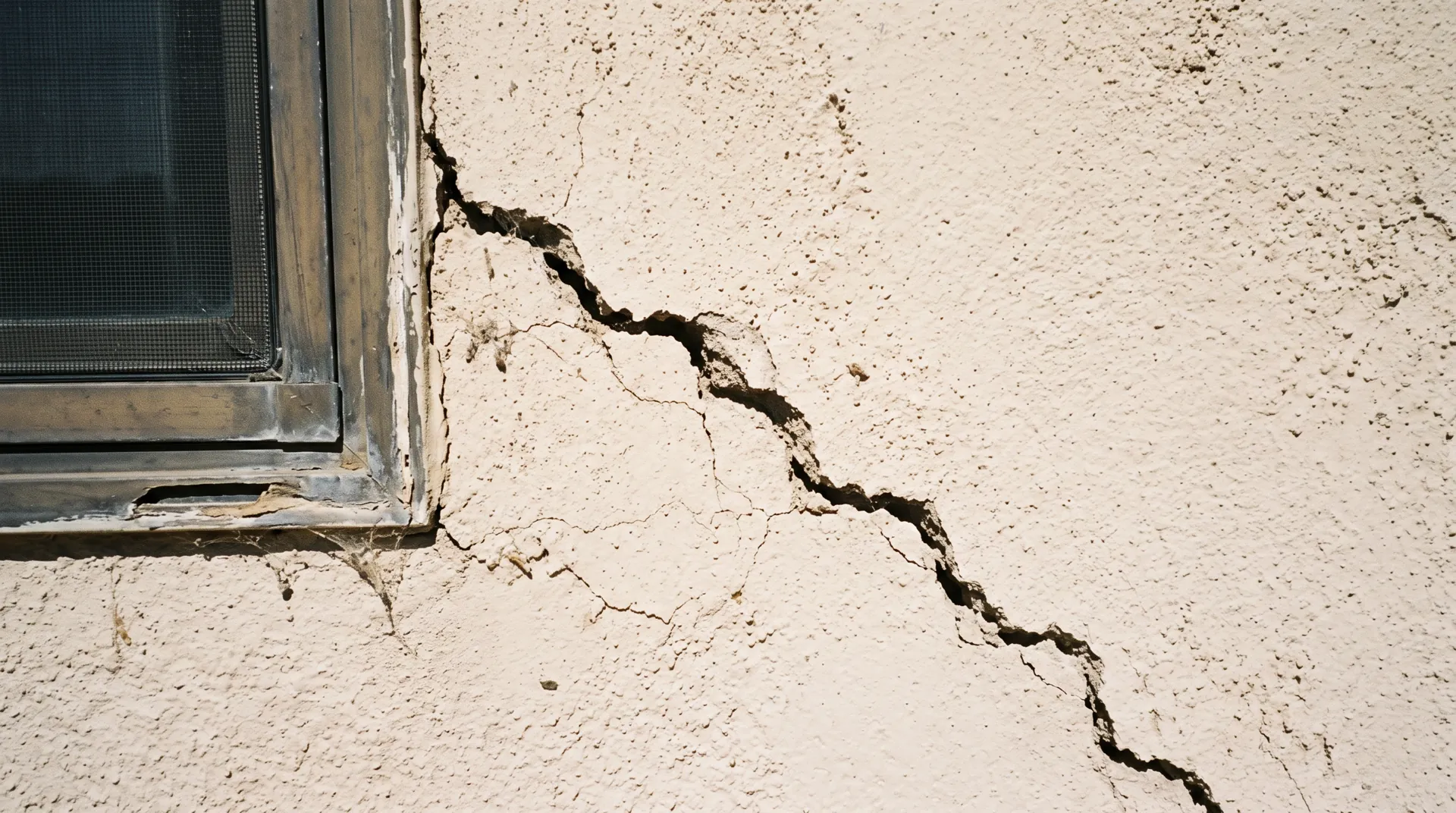
Diagonal cracks that run off the corners of windows, doors and garage openings. Openings are weak points in a wall, so movement shows up there first.
Long horizontal or vertical cracks
A straight line across a wall, sometimes along the line of the framing or where two sheets of lath meet.
Cracks at the base
A gap or crack where stucco meets the foundation or the weep screed, sometimes with the bottom edge pulling away.
Cracks that are growing
A crack wider than about 1/8 inch, one edge sitting higher than the other, or a crack that keeps coming back after it was caulked.
Cracks with company
Staining, bubbling paint or efflorescence (white crusty deposits) along the crack. That often means water is moving through it.
What usually causes it in Southern Utah
Expansive blue clay. Some parts of the area sit on clay that swells when it gets wet and shrinks as it dries. A slab on that ground lifts and drops a little with the seasons, and rigid stucco cracks to make room.
Collapsible soil. Other lots have soils that settle suddenly once they’re soaked. A broken line, a leaky sprinkler or poor drainage can trigger it. Local foundation companies point to this as a source of stucco gaps and cracks.
New build shrinkage. Stucco shrinks as it cures. On homes that went up quickly during the building boom, missing or poorly placed control joints can leave the wall nowhere to relieve that stress, so it cracks on its own schedule.
Heat swings. A wall that hits well over 100 degrees in the afternoon and cools down hard at night moves every day. Over years, that opens fine cracks, especially on west and south facing walls.
Freeze thaw up north. In Cedar City, water that gets into a crack can freeze and widen it each winter.
Settling and framing. Wood framing dries and settles in the first years after a build. Additions and casitas tied into an older wall can also crack at the joint.
Hairline or structural: when to worry
Most hairline cracks are cosmetic, but they still matter here because monsoon rain can drive water into them. Call for a closer look if you see:
- Cracks wider than about 1/8 inch, or ones that keep growing
- One side of the crack sticking out farther than the other
- Stair step cracks along with doors or windows that suddenly stick
- Cracks in the stucco plus cracks in the slab, garage floor or drywall inside
- Stains, soft spots or musty smells near the crack
When soil movement is the cause, the stucco contractor may suggest you also talk with a foundation or drainage specialist. Patching a crack over ground that is still moving usually means patching it again.
How the repair usually works
- Reads the crack. The crew looks at the width, the pattern and where it starts. Pattern is a big clue: a web points to shrinkage, stair steps point to movement, base cracks point to settling or water.
- Checks for water. They look for staining and soft spots and may check moisture around the crack before sealing anything in.
- Opens the crack. Fine cracks are often widened slightly into a small groove so filler can bond, instead of sitting on the surface.
- Fills with a flexible material. Many hairline cracks are filled with an elastomeric patch or a stucco matched sealant that can move a little with the wall.
- Rebuilds bigger cracks. Wider or recurring cracks may be cut out and rebuilt in layers, sometimes with mesh to bridge the crack. Where joints were missing, the crew may suggest adding one.
- Matches texture and color. The finish is worked to blend in. A crack repair often ends with paint or elastomeric coating so the lines don’t show through. See stucco painting and elastomeric coating.
Cost
National cost guide ranges, not a quote: crack repair often runs about $300 to $1,500, depending on how long the cracks are and what’s causing them. Cracks that need to be cut out and rebuilt fall into the broader stucco repair range of about $600 to $3,000, and coating the wall afterward adds to the total. See the stucco repair cost guide for details.
When to act
- Right away: wide or growing cracks, cracks with staining, and anything near a door or window that has started sticking.
- Before monsoon season: hairline cracks on walls that face storms, and cracks below parapets or windows.
- Keep an eye on it: a few fine cosmetic lines on a dry wall. Snap a photo with a coin or tape measure for scale and compare in six months.
Related help
- Cracks leaking or staining? See stucco water damage and inspection.
- Pieces breaking off around the crack? See stucco repair.
- In Hurricane? See stucco repair in Hurricane.
- In Santa Clara? See stucco repair in Santa Clara.
Stucco crack repair FAQ
- Are hairline cracks normal? Very common, especially on newer homes. They still let water in, so sealing them is smart.
- Can I just caulk it? Clear silicone tends to collect red dust and won’t take paint. A crack filler made for stucco works better, and wide cracks need more than caulk.
- Will the crack come back? It can if the cause isn’t handled. Flexible fillers and fixing drainage help.
- Does a crack mean foundation trouble? Not always. Wide, growing or stair step cracks are worth a closer look.
- How do I check the contractor? Ask for their Utah license number and verify it with DOPL.
Send a photo of the crack
Take one photo of the whole wall and one close up with a coin next to the crack for scale. Text them to [435 NUMBER] or use the free estimate form, and we’ll connect you with a local crew for a free written estimate.
Red Cliffs Stucco Co. connects Southern Utah property owners with independent local stucco contractors.