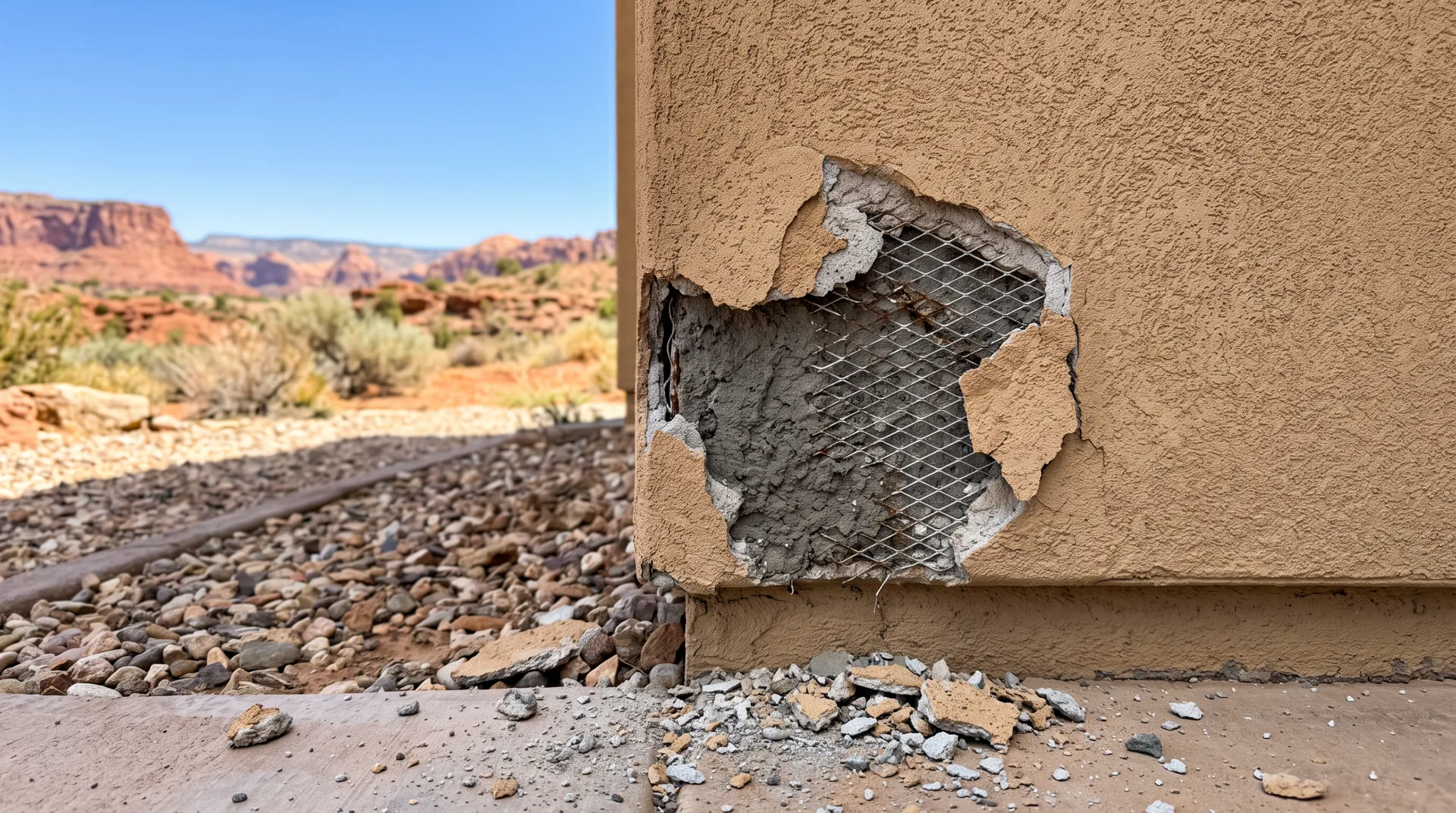
A hole where the old satellite dish used to be. A garage corner clipped by the boat trailer. A patch from years ago that finally let go. Most stucco damage like this is local, and a good repair fixes the spot without redoing the whole house.
Tell us what you’re seeing and we’ll get a team over for a free written estimate.
Text us a photo at [435 NUMBER]
Signs to look for
Holes and gaps
Anything from screw holes to an opening big enough to see the wire behind it. They often show up where a light, camera, hose bib, dish or sign was taken down and never filled properly.
Chips and flaking
Pieces of the top coat popping off, usually low on the wall, around window trim, or where a gate swings into the stucco.
Loose or bulging stucco
A section that has pulled away from the wall. It might bow out, sound hollow when you tap it, or flex when pushed. Treat it gently. Loose stucco can drop without warning.
Broken corners
Outside corners on garages, columns and courtyard walls take hits from cars, mowers, bikes and ladders. The corner bead underneath can bend or rust once it’s exposed.
Impact damage
A round spot of cracks from a golf ball, a branch, a rock thrown by a mower, or a careless swing of a tool.
Failed old patches
A ring around an earlier repair, a patch that’s a different color, or one that sounds hollow while the wall around it sounds solid.
What usually causes it in Southern Utah
Daily knocks. Many homes here have RV pads, side yards and tight three car garages. Trailers, ATVs, golf carts and yard tools all find the corners eventually.
Sun baked finish. Long stretches over 100 degrees dry out the finish coat. Brittle stucco chips more easily when something hits it.
Water at the base. Sprinklers and drip lines often soak the bottom of the wall. Repeated wetting weakens the stucco near the ground and can rust the lath and weep screed. If you see staining with the damage, read about stucco water damage.
Moving soils. Expansive blue clay and collapsible soils can shift a slab enough to crack stucco and loosen sections. If the damage looks more like long lines than holes, see stucco crack repair.
Monsoon wind. Late summer storms throw branches, patio furniture and debris into walls.
Quick fixes that didn’t last. A patch made with the wrong mix, or one that skipped a layer, tends to crack around the edges or pop out within a few summers.
Rentals and empty homes. Short term rentals and snowbird homes often collect small dings between visits, and nobody notices until a chip has turned into a hole.
How the repair usually works
Traditional stucco goes on in layers, and a lasting patch rebuilds those layers instead of smearing filler over the surface. Here is what a crew typically does.
- Sizes up the damage. The contractor taps around the area to find where solid stucco starts and checks for any sign of moisture.
- Cuts back to sound material. Loose and crumbling stucco comes out. Clean, firm edges give the new material something to grab.
- Fixes what’s underneath. Rusted lath, bent corner bead or torn building paper gets repaired or replaced so water stays out.
- Builds the base coats. A scratch coat goes on first and gets scored, then a brown coat brings the patch out to the right thickness. Each layer needs time to cure, which in summer heat often means keeping it damp.
- Matches the texture. The finish coat is worked to match the wall around it, whether that’s a light sand, dash, lace or smooth finish. This step decides whether a patch disappears.
- Blends the color. New material rarely matches sun faded walls on day one. Many jobs end with paint or coating on the patched wall, or the whole elevation, to tie it in. HOA homes may need an approved color. See stucco painting and elastomeric coating.
A small hole can be a short job. Loose sections and broken corners take longer because old material has to come off and each coat has to cure.
Cost
National cost guide ranges, not a quote: small patches are often about $200 to $600, and most stucco repair jobs land around $600 to $3,000. The size of the area, how many spots there are, wall height, lath or corner bead repair, and color blending all move the price. The stucco repair cost guide explains each factor.
When to act
- Right away: loose or bulging stucco, exposed wire or lath, and any hole that goes all the way into the wall. Water, insects and critters can get in.
- Soon: chips, broken corners and patches that are starting to lift. Each storm makes them bigger.
- When it suits you: a small, shallow, dry ding.
If you can, get open damage handled before monsoon season starts in July. Spring and fall are also easier on fresh stucco than the hottest weeks of summer.
Related help
- Seeing cracks instead of holes? See stucco crack repair.
- Stains, bubbling or soft spots near the damage? See stucco water damage and inspection.
- Is the dented spot soft foam trim? See EIFS repair.
- In St. George? See stucco repair in St. George.
- In Washington? See stucco repair in Washington.
Stucco repair FAQ
- Can one hole be fixed without redoing the wall? Yes. Most repairs are local to the damaged area.
- Will the patch show? The crew works the texture to match and blends color. Older, faded walls usually need paint or coating to fully disappear.
- Can I use a patch kit from the hardware store? For a nail hole, maybe. Anything bigger needs proper layers to last in this heat.
- Should I fix the sprinkler first? Usually, yes. Ask the contractor, since redirecting spray protects the new patch.
- How do I check the contractor? Ask for their Utah license number and look it up with DOPL. Stucco work falls under S270 and S230.
Send a photo of the damage
Text a wide photo and a close photo to [435 NUMBER], or use the free estimate form. We’ll connect you with a local crew for a free written estimate.
Red Cliffs Stucco Co. connects Southern Utah property owners with independent local stucco contractors.