Some walls are past patching. The finish is cracked in a dozen places, old repairs keep popping loose, or water has gotten behind more than one section. Other times the house is fine, but you are adding a casita, a garage bay or a courtyard wall and want new stucco that looks like it was always there.
Tell us what you’re seeing and we’ll get a team over for a free written estimate. An independent local stucco contractor looks at the walls, explains whether repair or restucco makes more sense, and puts the price in writing.
Text us a photo at [435 NUMBER]
When restucco makes sense
Most stucco problems are fixed with a repair, not a whole new coat. A restucco is worth talking about when you see several of these at once.
Cracks on most sides of the house
One crack by a window is a repair. Cracks running across every wall, or the same cracks coming back after they were filled, can mean the finish has reached the end of its life.
Patches that do not hold
If past repairs keep separating, show rings around the edges, or sound hollow when you tap them, the bond underneath may be failing in more places than you can see.
Water damage in more than one spot
Stains under several windows or soft areas near the base of walls can point to trouble with the paper and lath behind the stucco. See stucco water damage and inspection for how a crew checks the wall first.
Faded, chalky or mismatched walls
Years of desert sun can leave a finish dull, powdery and blotchy. Sometimes a coating fixes this. The stucco painting and elastomeric coating page covers the coating route.
New construction on an existing home
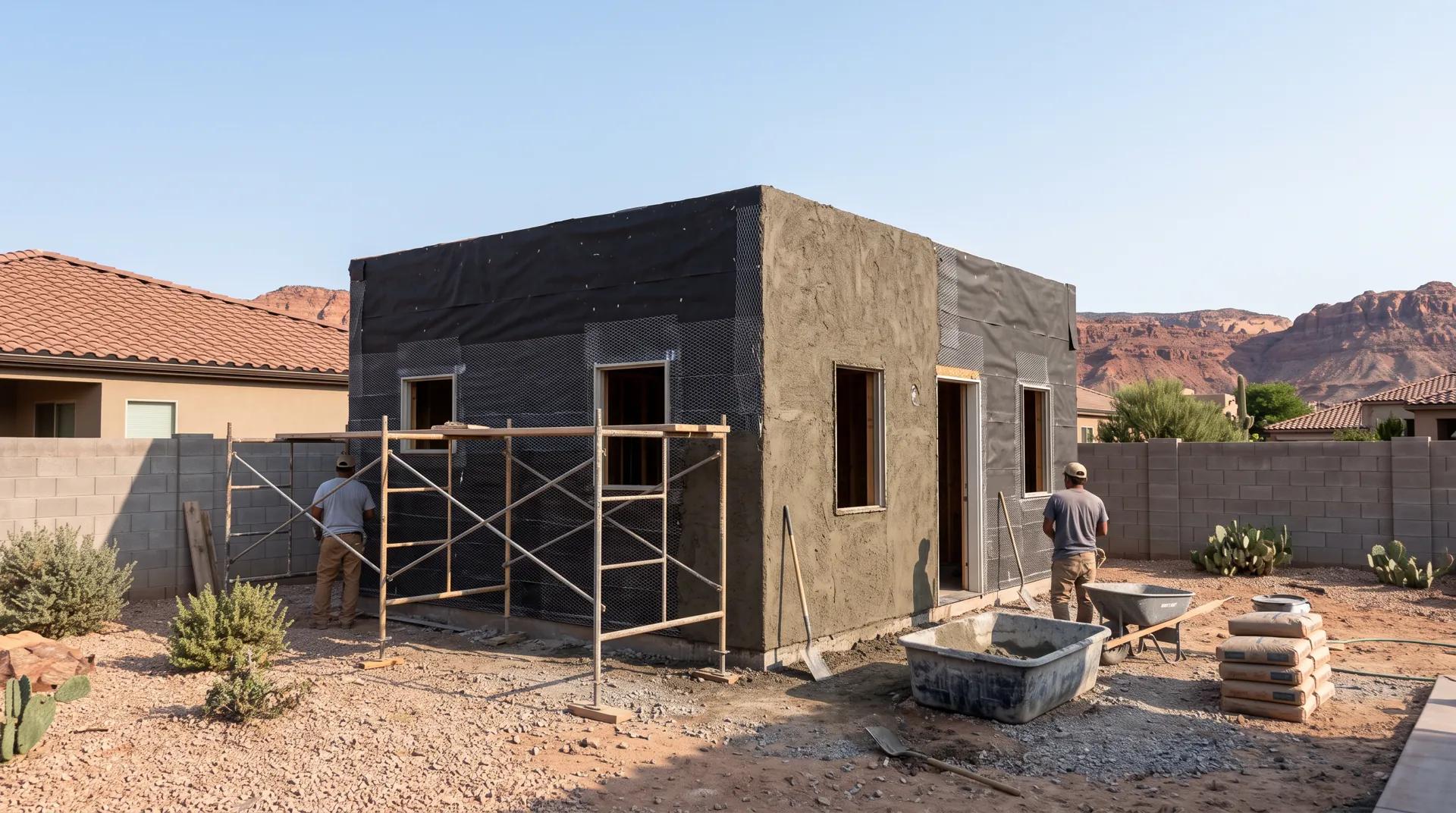
Additions, casitas, enclosed patios, new garden and courtyard walls, and pony walls around a pool all need new stucco that ties into what is already there.
Why walls wear out in Southern Utah
Sun and heat. Summers in St. George often pass 100 degrees, and cool nights follow hot days. Over time the finish coat dries out, fades and cracks.
Problem soils. Local foundation companies point to expansive blue clay that swells when wet and collapsible soils that settle when soaked. Either one can move a slab or footing enough to crack the stucco above it, and that movement often shows up on garden walls first.
Monsoon storms. From roughly July to September, sudden heavy rain and wind push water into any opening. Walls that already had small cracks take on more water every season.
Fast building. Many homes in Washington County went up quickly, and some production stucco is now showing cracks and stained weep screeds early.
Parapets and flat roofs. Parapet walls around flat roofs are a common leak spot. Cracked caps let water run down inside the wall.
One coat vs three coat stucco
You will hear these two terms from contractors, and it helps to know the difference before you compare estimates.
- Three coat stucco is the traditional method. A scratch coat goes over paper and wire lath, then a brown coat builds thickness, then a finish coat adds color and texture. It is thicker and takes longer, since each coat needs time to cure.
- One coat stucco is a newer system. A single base coat goes on over foam board or lath, followed by a finish coat. Many newer homes in the area were built this way. It goes up faster and is usually thinner.
On a restucco or an addition, the crew usually tries to match the system already on the house so old and new walls weather the same way. Foam trim and EIFS accents need their own approach. See EIFS repair if you are not sure what is on your house.
Matching an existing home
The hard part of new stucco on an older house is making it disappear. A crew will usually focus on two things.
- Texture. Sand, lace, dash, smooth and Santa Barbara style finishes are all common here. Matching one by hand takes practice.
- Color. Sun baked stucco is lighter than new material. Many jobs end with paint or a coating on the full wall, or the full house, so the color reads as one.
HOA approvals
Many St. George area neighborhoods have HOA rules on exterior color and texture. Before any restucco or addition, check what your HOA needs. That often means submitting a color, a texture and sometimes a sample or a drawing for approval. Ask the contractor for a written scope and color information you can attach to the request. Plan for the approval time when you think about scheduling.
How the work usually goes
- Visit and estimate. The crew walks the property, taps the walls, looks for moisture and checks the system on the house. You get a written estimate that says what will be removed, what will be rebuilt and how the finish will match.
- Prep and protection. Windows, doors, plants and hardscape get covered, and nearby sprinklers get shut off.
- Removal where needed. For a full restucco, failed stucco is cut back. Some jobs go over sound existing stucco with a new finish coat instead. The crew decides based on what they find.
- Paper and lath. Torn or rotted paper and rusted wire get replaced so water has a path out of the wall.
- Base coats. One coat or three coat, depending on the system. Each layer is given time to cure.
- Finish coat. The crew applies the texture and color agreed on in the estimate.
- Paint or coating. If the plan calls for it, the walls get a coat once the stucco has cured long enough.
A garden wall can take a few days. A full restucco takes longer, since curing time is part of the job.
Cost
National cost guide ranges, not a quote: full restucco often runs about $8 to $15 per square foot, and national guides vary widely. Height, parapets, removal, lath repair, texture and the size of the house all move that number. Smaller jobs like a garden wall or a short section tied into an existing house are usually priced per job instead. The stucco repair cost guide explains what drives the price and how to compare estimates.
When to plan it
- Best windows: spring and fall. Mild temperatures help stucco cure evenly.
- Harder months: peak summer, when afternoons over 100 degrees can dry fresh stucco too fast, and the monsoon months of roughly July to September, when sudden storms can soak an open wall.
- Cedar City and higher areas: winter freezes can slow or stop the work, so spring through early fall is usually easier.
- Allow time for HOA review before your preferred start.
Related help
- Only a few damaged spots? See stucco repair.
- Cracks that keep coming back? See stucco crack repair.
- Stains or soft spots? See stucco water damage and inspection.
- In St. George? See stucco repair in St. George.
- In Washington? See stucco repair in Washington.
Restucco FAQ
- Can new stucco go over old stucco? Sometimes, if the old stucco is solid and well bonded. If it is loose or wet behind, it needs to come off first. The crew decides after looking.
- Will an addition match the house? A crew works to match texture and color, and painting the full wall often helps. Very old or faded walls take more care.
- Is restucco always needed when walls crack a lot? No. Many walls only need crack repair and a coating. Ask the contractor to explain why they suggest one or the other.
- What about my HOA? Check your HOA’s rules and get approval before work starts. The written estimate helps with that request.
Send a photo of the walls
Tell us what you’re seeing and we’ll get a team over for a free written estimate. Text a wide photo and a close photo to [435 NUMBER], or use the free estimate form.
Red Cliffs Stucco Co. connects Southern Utah property owners with independent local stucco contractors.